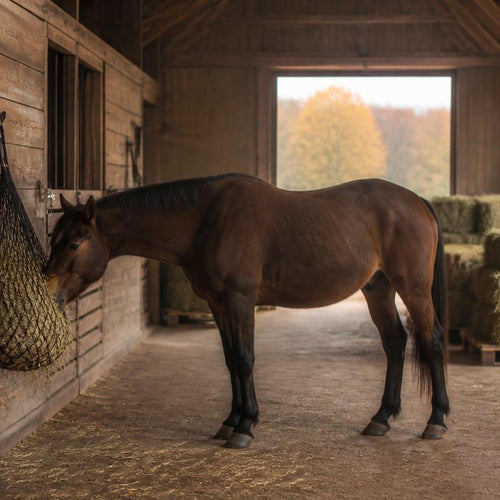
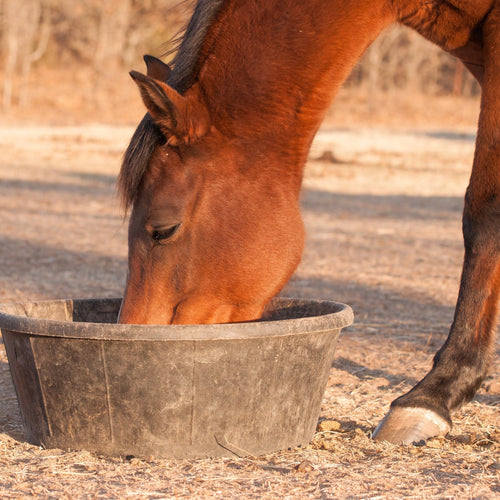
It usually starts small. The horse who used to clean up his feed tub starts walking away from it halfway through. He swishes his tail and pins his ears when you do up the girth, when he used to just stand there and doze. Maybe his coat has lost its shine even though nothing about his feeding has changed, or he's sticky off your leg in a way that doesn't feel like plain laziness.
None of those things on its own means ulcers. Put a few of them together in a horse who hauls, lives mostly in a stall, or works hard, and it's worth paying attention. Here are the signs owners tend to notice first, when to get your vet out, and how ImmuBiome G-Tract fits into the routine of a horse whose gut needs support.
Why horses are prone to ulcers
A horse's stomach makes acid around the clock, whether or not there's anything in it. In nature that works out fine, because a grazing horse is chewing most of the day, and all that forage and saliva help buffer the acid. The upper part of the stomach has very little protection of its own, so it depends on that steady supply.
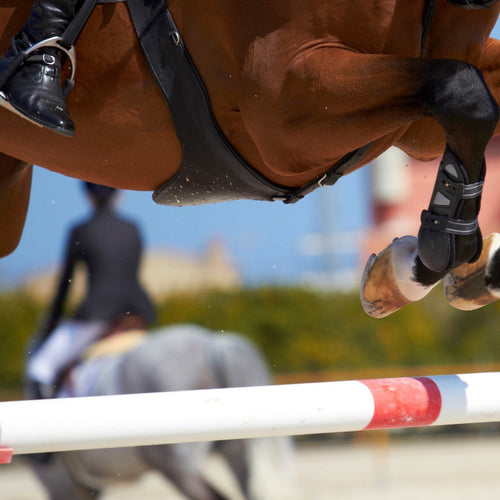
Our modern routines don't always cooperate. Long gaps between meals, hours in a stall, trailer trips and hard work all leave the stomach empty or splash acid where it doesn't belong. That's why ulcers come up so often with show and performance horses. Our GI series post on gastric ulceration goes into the anatomy if you want the full picture.
The signs owners notice first
Most of these are quiet changes rather than anything dramatic, and you're the one most likely to catch them:
- He gets girthy. Ears back, tail swishing, a cranky swing of the head or a cow kick when the girth comes up.
- He gets picky. He eats slower, leaves feed behind, or walks off and comes back to it.
- His coat goes dull, or a little weight slides off a horse who's normally easy to keep.
- He's less willing under saddle. Behind the leg, resistant in transitions, or just not as forward and honest as usual.
- His attitude changes in the stall or on the crossties. Grumpy, withdrawn, or sour about things he used to accept.
- He has mild, repeated bouts of discomfort, like lying down more, looking at his side, or stretching out as if to urinate.
- His manure changes or gets loose, which can point further back toward the hindgut.
Girthiness is a good example of why these signs need sorting out by a professional. When the veterinary hospital at UC Davis looked back at 37 horses brought in for girthiness, 12 turned out to have gastric ulcers. But 10 had orthopedic problems, 3 had saddles that didn't fit, and the rest had a mix of other conditions (Journal of Equine Veterinary Science, 2019). A girthy horse could be telling you about his stomach, his back or his tack.
Stomach or hindgut?
Gastric ulcers sit in the stomach. The hindgut, the cecum and colon where fiber is fermented by billions of microbes, can have its own trouble, and the signs overlap. Loose manure and a horse who's off his feed show up with both. The hindgut is also much harder for your vet to look at directly, which is one more reason not to guess.
Our gut health page explains how the front and back of the tract work together, and our page on leaky gut covers the gut barrier that lines the whole system.
When to call your vet
Call right away if you see signs of colic: pawing, rolling, getting up and down, no manure, or no interest in food at all. That isn't a wait-and-see situation.
For the quieter signs, book an exam. Gastroscopy, where your vet passes a scope into the stomach, is the only way to confirm gastric ulcers, and a good workup will also look at soundness, saddle fit and other causes. Diagnosis and medication are your vet's department. Before the appointment, jot down what you've noticed and roughly when it started. That list helps more than you'd think.
Day-to-day habits that help
A lot of what supports the stomach costs nothing:
- Keep forage in front of him as much as you can. Slow feeders and more turnout mean fewer empty hours.
- Split hard feed into smaller meals rather than one or two big ones.
- Give him some hay before you ride so he isn't working on an empty stomach.
- Offer hay and water on the trailer, and bring water from home if he's fussy at shows.
- Keep his routine as steady as possible around shows, barn moves and feed changes.
Our Ulcer Protocol post goes deeper on building the barn routine around the horse's stomach.
How ImmuBiome supports the gut
Everything ImmuBiome makes starts in the gut. We've spent over a decade working with mushrooms and performance horses, and every formula is veterinarian formulated around one idea: a well-fed microbiome and a healthy gut lining support the whole horse.
Most of our formulas pair organic mushroom mycelium with human-grade bovine colostrum and probiotics.
Where G-Tract fits
G-Tract is our foregut-to-hindgut formula. It's built for horses whose owners want everyday gut comfort and digestive balance, especially through training, travel and feed changes. Here's what goes into it and why:
- Turkey Tail and Lion's Mane mushrooms bring prebiotic fibers that feed the beneficial bacteria in the hindgut, along with 1,3-1,6 beta-glucans.
- Bovine colostrum, collected within 16 hours of calving, supplies nutrients that support the natural health of the stomach and gut lining.
- Live yeast, Saccharomyces cerevisiae and Saccharomyces boulardii, supports healthy digestion.
- Eight probiotic strains support a balanced microbiome and nutrient absorption.
Together they support a healthy stomach and hindgut lining, normal digestive comfort, normal manure consistency and digestive balance when the routine changes. G-Tract is FEI-friendly and made in the USA, and it's meant to sit alongside your vet's plan, not replace it.

Shop the post
From $69 (300 g)
Turkey Tail, Lion's Mane, colostrum, live yeast and probiotics for everyday support from the stomach to the hindgut.
Shop G-TractIf your horse has dropped weight or lost some topline while his gut has been off, our Ulcer Protocol pairs G-Tract with ImmuBiome Lean Muscle. Lean Muscle is built around human-grade bovine colostrum, which the label lists at 8,750 mg, the most of any ImmuBiome formula. Alongside it are organic Reishi mushroom and the same eight probiotic strains you'll find in G-Tract. It's formulated to support lean muscle development, topline and hind end strength, and muscle recovery after hard work, so it's a natural partner while you and your vet get his gut back on track.

From $134 (420 g)
Colostrum, Reishi and probiotics to support topline and lean muscle while the gut gets back on track.
Who G-Tract is for
G-Tract suits show and performance horses, horses who haul often or spend a lot of time in a stall, horses going through a barn move or a hay change, and any horse whose owner wants daily gut support once the vet has had a look. You'll find G-Tract in our Hindgut & Ulcer Support collection and Lean Muscle in our Muscle Building collection, and US subscriptions ship free.
Owner questions about ulcer signs
Can I tell if my horse has ulcers just from how he acts?
No. Behavior can make you suspicious, but the signs overlap with sore backs, poor saddle fit and plenty of other problems. A vet exam, usually with gastroscopy for the stomach, is how you find out.
Why is my horse suddenly girthy?
Ulcers are one common reason, but not the only one. In the UC Davis review of 37 girthy horses, about a third had gastric ulcers, and others had orthopedic problems or saddles that didn't fit. Have your vet and your saddle fitter take a look.
Will G-Tract get rid of my horse's ulcers?
No supplement should promise that. G-Tract is daily nutritional support for a healthy stomach and hindgut lining and normal digestive comfort. Your vet handles diagnosis and medication, and G-Tract fits alongside that plan.
Can I keep feeding G-Tract at shows and on the road?
Yes. It's FEI-friendly, and it was formulated with training, travel and feed changes in mind, so a lot of owners keep it going right through show season.
What's the difference between G-Tract and Lean Muscle?
G-Tract is the everyday foregut-to-hindgut formula, with Turkey Tail, Lion's Mane, colostrum, live yeast and probiotics. Lean Muscle is built around colostrum, with Reishi and probiotics, to support topline and lean muscle. Our ulcer protocol pairs the two for horses who need gut support and help holding their condition.
These statements are about nutritional support only. ImmuBiome supplements are not drugs and don't take the place of veterinary care. Talk with your veterinarian about your horse's specific needs.