Most of us know the feeling. The last cutting finally came in between rain showers, the loft is full, and you feel ready for winter. Then you crack a bale in November and get a puff of gray dust and that sweet, musty smell. Or the stack near the back wall feels warm when you put your hand between the bales.
Fall is when hay that was baled a little too wet, or stored a little too tight, starts to show itself. Wet weather at harvest, humid barns, and condensation under tarps all give mold a head start. And because horses eat forage all day, every day, the hay pile and the feed room are where most horses meet mold and mycotoxins.
We covered the background on mold types and mycotoxins in an earlier post, Mold and Mycotoxin Contamination in the Equine Diet. This one is the practical companion: how wet hay goes bad, how to store and check what you have, when to test, and how to look after your horse's gut while you sort it out.
How good hay turns moldy
Hay isn't inert once it's baled. Freshly baled forage keeps "sweating" for a while as plant cells and the bacteria on them use up sugars and give off heat and moisture. In dry hay, that heat fades away harmlessly. In hay that went into the bale with too much moisture, or that picks up moisture later, the heat and humidity stay trapped, and the molds that are always present on plants get the conditions they like.
University of Minnesota Extension has a useful rule of thumb for moisture at baling. Hay baled at 10–15% moisture is in the recommended range, with the least risk. At 16–20% it could mold without a preservative, and at 21–25% it will likely mold without one. Over 25% means severe heat damage and a high fire risk.
You'll hear about two molds in particular, Aspergillus and Fusarium. Both are common in wet hay and both can produce mycotoxins. A mycotoxin is a compound the mold makes, not the mold itself, and the difference matters because the toxins are quite stable. Brushing off a moldy patch, airing out a flake, or soaking the hay does not get rid of them.
Why moldy feed is a gut problem first
Horses can't vomit, so whatever goes into the mouth makes the whole trip through the stomach and small intestine into the hindgut. The lining of that tract is the first tissue that meets anything in the feed, and it is also where a huge share of the horse's immune activity happens. Down in the cecum and colon, a large, busy community of microbes ferments fiber into energy, and that community doesn't like change. If you'd like a refresher on how it works, our post Getting To Know the Horse's Microbiota walks through it.
Moldy hay hits a horse in two ways. The spores and dust get breathed in at the hay net, and the hay and any toxins get swallowed. UMN Extension lists colic, heaves, and respiratory illness among the problems linked to moldy hay. The early signs in the barn are often vague: a horse who picks at his hay, a cough at feeding time, looser manure, a dull coat, or a horse who just isn't quite himself. Any of those can have a dozen causes, so let your veterinarian be the one to sort them out.
There's a quieter gut issue too. Finding a bad batch usually means changing hay quickly, and a sudden forage switch is one of the bigger disruptions the hindgut has to handle.
Storing fall hay so it stays good
None of this needs a product. It needs a few habits.
- Ask before you buy. A good grower won't mind questions about cutting date, weather at baling, and whether a preservative was used. Buy from someone whose hay you have fed before when you can.
- Keep an eye on new hay for the first six weeks, since that's when heating is most likely. A hay probe or a long thermometer pushed into the middle of the stack tells you more than a hand on the outside. UMN's guidance: under 130°F is the least risk, 130–140°F means keep checking, around 150°F means check often, and at 175–190°F fire is imminent, so call the fire department and don't move the bales yourself.
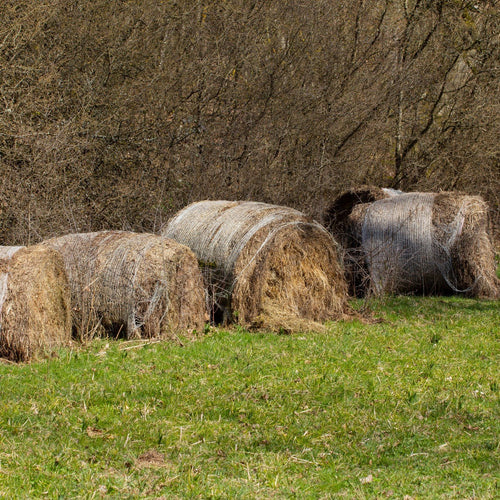
- Get it off the ground and give it air. Stack on pallets, leave a gap from exterior walls, and keep the loft or shed ventilated. Round bales stored outside do best up off the ground and covered on top, with the sides able to breathe.
- Feed the oldest hay first, and keep track of which load came from where.
- Keep grain dry and sealed. Store concentrates in clean, closed bins, use them while fresh, and don't buy bags that are torn or have been wet. Rinse and dry feed tubs and buckets regularly, especially in damp weather.
- Look at it and smell it every time you feed. Good hay breaks apart easily and smells like hay. Be suspicious of flakes that are warm, stuck together in clumps, white or gray and dusty, dark or blackened, or that smell musty or sour.
- If part of a bale is moldy, toss the entire bale, not just the bad flake. The mold you can see is only part of what's there.
When and how to test your hay
If you buy hay by the load or the season, a forage test pays for itself. A few things catch owners out:
- A routine nutrient analysis usually doesn't include mold. Ask the lab specifically for a mold count or a mycotoxin panel. Your county extension office or veterinarian can point you to a forage lab.
- Mold and mycotoxins aren't spread evenly through a load, so sample well. Use a hay probe to take cores from a number of bales across the same cutting, rather than grabbing a handful from one flake.
- UMN Extension notes that because horses are sensitive to mold, their feed should contain little of it: less than 1 million colony forming units per gram.
- Keep a sample from every load. A labeled zip-top bag of hay, and one from each bag of feed, kept somewhere cool and dry, makes it much easier for your vet to investigate if a horse gets sick weeks later.
If a horse shows colic signs, a new cough, stops eating, loses weight, has ongoing loose manure, or seems neurologically "off," call your veterinarian first. Bring your samples. Diagnosis and treatment belong with your vet. Everything above is about lowering exposure.
Supporting the gut through a hay change
Once the bad hay is gone, most horses face what the gut feels as a sudden feed change: new forage, sometimes a different type, often with little time to transition. Change hay gradually over a week or so whenever you can, mixing old and new. When you can't, keep forage in front of the horse, keep turnout and routine steady, cut back on sugary feeds, and make sure water and salt are always available.
A daily digestive supplement can fit in here, as one part of a plan you've made with your vet. Our ImmuBiome G-Tract is formulated for foregut-to-hindgut digestive support, including digestive balance during training, travel, and feed changes. Here's what goes into each 10-gram scoop and why:
- Turkey Tail and Lion's Mane mushrooms. The organic mushroom blend provides 5,500 mg of prebiotics per serving to feed beneficial gut bacteria. Turkey Tail also helps support a balanced immune system and provides antioxidant support.
- Probiotics and live yeast. Over 3 billion CFU of probiotic strains help support a balanced microbiome and nutrient absorption. Alongside them are 25 billion CFU of Saccharomyces yeast cultures, including S. boulardii, to support healthy digestion.
- Bovine colostrum (1,500 mg). Human-grade colostrum supplies nutrients that support the natural health of the stomach and gut lining.
- Beta-glucans (25% minimum). These help support immune and gut resilience, which ties into the gut-first idea behind every ImmuBiome formula.
G-Tract has no sugars, molasses, or fillers, and each batch is independently tested for potency, purity, and contaminants.
To be clear, G-Tract is nutritional support. It isn't a toxin binder, and it doesn't make moldy hay safe to feed. The hay comes first.
Is G-Tract right for your horse?
G-Tract is a good fit for horses going through a hay or feed change this fall, for show and performance horses whose routines are already demanding, and for any horse whose owner wants everyday hindgut and stomach comfort. Mix it thoroughly into damp feed. For a 1,000 lb horse, the label calls for 1 scoop daily. For picky eaters, start with ¼ to ½ scoop for a few days and work up. Your veterinarian can help you adjust the amount to your horse's workload and needs.
You can find G-Tract alongside our other digestive formulas in Hindgut & Ulcer Support, and US subscriptions ship free.

Questions from horse owners
Can I just pull out the moldy part of the flake and feed the rest? No. Mold and mycotoxins spread beyond what you can see, so if part of a bale is moldy, discard the whole bale. If a lot of a load looks off, set it aside, test it, and talk to your supplier.
Will soaking or steaming my hay get rid of the mold? Soaking and steaming can reduce dust at feeding time, which helps some horses. They don't make moldy hay safe, because mycotoxins are stable and don't rinse out. Start with clean hay, and use soaking or steaming as a dust-control step on top of that.
My horse ate some bad hay before I caught it. Will G-Tract clear the mycotoxins out? No supplement should promise that. G-Tract isn't a binder or a detox product, and it isn't intended to diagnose, treat, cure, or prevent any disease. Remove the hay, save a sample, and call your veterinarian, especially if your horse is off his feed, coughing, colicky, or has loose manure. Once your vet has a plan, G-Tract can be part of supporting normal digestion through the hay change.
These statements are about nutritional support. ImmuBiome supplements are not intended to diagnose, treat, cure, or prevent any disease. Talk with your veterinarian about your horse's specific needs.